
Client: Athens Achieves and Athens Area Chamber of Commerce
Location: Athens, Georgia
Organization Type: Large Non-Profit
Service Provided: Marketing strategy, video production, and distribution consulting
Outcome: Formulated a clear and effective marketing strategy that got the students excited to attend the event and motivated donors to continue supporting it
Client Overview
Athens-Clarke County, Georgia has two problems that, at first glance, don’t seem related.
The first: roughly one in four residents lives in poverty. And most of them are kids. The second: there aren’t enough workers to fill every open job in the county. If every job seeker were matched one-for-one with an open position, there would be jobs left over.
Athens Achieves, a workforce development initiative launched by the Athens Area Chamber of Commerce, is working to solve both problems at once. By necessity, their vision is long-term. Any real solution will take decades and will need multiple community partners to work in concert.
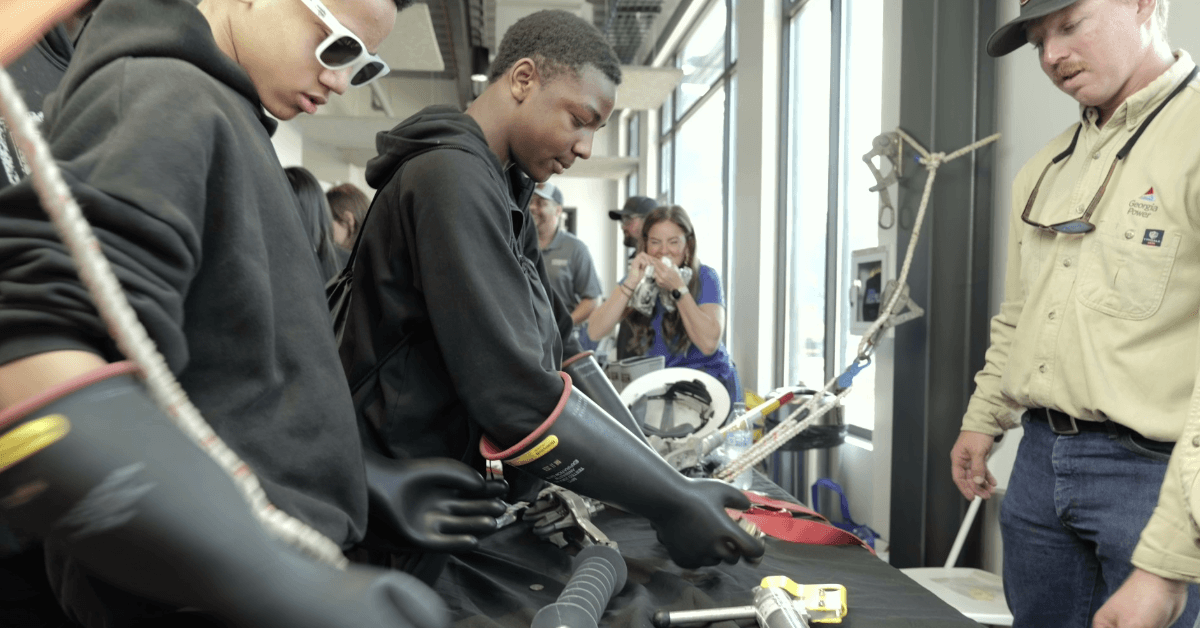
They reached out to me to spearhead the marketing for one of the first steps in that plan, the Wonders of Work Futures Fair. This is an event where area employers come together to show eighth graders how cool their industries are. It’s not a job fair (the kids aren’t getting hired). The goal is to inspire them. Give them a glimpse of what’s possible.
I partnered with Calor Creative, a local design firm, on this project. Calor handled visual identity and creative assets, and I oversaw marketing strategy and video.
The event was a resounding success. Here’s how it unfolded.
The Challenge
Naming the Event
Athens Achieves put forward a very strong event concept. What they didn’t have was a consistent name, a clear brand, or a marketing strategy focused on their target audience. In early conversations, organizers were calling the event a “career showcase,” a “job fair,” and a few other things. None of them felt quite right.
The Primary Audience
Beyond the name, we faced a deeper marketing challenge.
The primary audience was approximately 800 eighth graders in Athens-Clarke County schools. Before I was hired, the main thrust of the marketing plan was to promote the event on social media. But here’s the thing: why would you try to reach 800 specific kids by advertising to the general public?
It all came down to one piece of crucial information: attendance wasn’t optional. The event was school-sanctioned, which meant the only way a student didn’t show up was if a parent actively opted them out.
So awareness wasn’t the challenge. Our main marketing objective was getting students genuinely excited. Excited enough for the event to leave a mark.
The Secondary Audience
And then there was a secondary audience: the community partners, sponsors, and donors who would want to see evidence that the event was worth backing again next year. Their needs were different, and the content for them couldn’t just be a highlight reel. They needed to hear from the students themselves.
The Solution
A. Start With Strategy.
Before doing any creative work, I delivered a foundational marketing strategy document. It established naming conventions, audience priorities, messaging principles, and the best practices that would govern every deliverable going forward.
My first recommendation in that document was this: stop calling it a career showcase or a job fair (there was inconsistency among stakeholders regarding what they called the event). Call it a Futures Fair.
It’s a small change with a big impact. “Career showcase” sounds like something your guidance counselor schedules. “Futures Fair” sounds like something you’d actually want to go to. The recommendation stuck. Athens Achieves adopted the name, and it made its way into the official wordmark.
That strategy document became the north star for everything that followed. When I brought videos in for approval, there were no surprises. Every decision we made had already been agreed upon in principle.
B. Find the Audience Where They Already Are.
Rather than defaulting to social media, I asked a different question: is there any way to get these videos in front of the students directly?
The answer, it turned out, was yes. Our partners at the Clarke County School District informed us that all of their schools hold weekly Friday advisement sessions, time set aside for students to learn about leadership, character development, and future possibilities. It’s exactly the kind of content I was making. We secured placement for three videos, one per Friday, in the three weeks leading up to the event.
C. Make Videos Eighth Graders Will Actually Watch.
Now I needed to make the videos. I didn’t want them to be too polished or corporate. They needed to be entertaining enough that a roomful of eighth graders would pay attention.
So I made them silly. Genuinely, intentionally, unambiguously silly. They’re ridiculous in the best way: designed to grab attention and hold it. The goal was to make the Futures Fair feel like something worth looking forward to, and based on what happened at the event, it worked.
D. Let the Students Tell the Story.
The final deliverable was the event recap video. This one was built for a different audience.
On-site at the Futures Fair, we ran an interview booth alongside standard B-roll and photography coverage. The focus was on capturing middle schoolers talking about their own (unscripted) experience at the event.
That footage became the core of the recap video. Because here’s the thing about donors and community partners: they don’t need you to tell them the event was impactful. They need to see it. A paragraph from the organization saying “our students loved it” is not the same as watching a thirteen-year-old light up talking about trying out a welding torch in a Virtual Reality simulation.
The Results
How did it go? Watch the recap video. The students speak for themselves.
Client Testimonials
“Rooster High provided a very thoughtful and high-quality product for the Wonders of Work event. Engagement with 8th-grade students was very helpful in creating a product that appealed to both the student population and industry partners, including Athens Technical College and the Clarke County School District.”
— Sally Kimel-Sheppard, Envision Athens
“We have used Rooster High for a couple of important projects. ALWAYS extraordinary!”
— David Bradley, CEO, Athens Area Chamber of Commerce
The Takeaway
Great storytelling starts with questions.
Who are we actually trying to reach? Where are they, and how do we get in front of them directly? What does “success” look like for each audience, and are those audiences different enough to require different approaches?
On this project, asking those questions led to a name change that transformed the event’s identity, a focused and effective distribution strategy, and a recap video built not to celebrate the event but to fund the next one.
That’s what strategy-first marketing looks like. And it’s what I bring to every project, whether you’re launching a community initiative, telling your organization’s story, or just trying to figure out what you want to say.
If you’re curious whether Rooster High is the right fit for your next project, [let’s connect].